

Have you ever eaten at a Sichuan (or Szechuan) restaurant and felt a strange, buzzing, tingly feeling on your tongue or inside your cheeks?
You're not imagining it — and there's no need to panic! That numbing sensation is real, and it's all thanks to one powerful little spice: Sichuan pepper.
For epicures of Chinese cuisine, it’s a familiar thrill. But if you’re new to it, you might mistake that tingling for just another type of chili heat. After all, Sichuan pepper is often paired with chilies in the iconic flavor duo known as málà (麻辣) — which literally means “numbing and spicy.”
But make no mistake — it’s doing something entirely different. Unlike chili peppers that burn (via capsaicin) or black pepper that bites (via piperine), Sichuan pepper delivers a distinctive buzzing, tingly-numbing sensation known in Chinese as má (麻). It’s this electric feeling — not just heat — that makes Sichuan cuisine so unforgettable.
So what’s really behind that strange, electric tingle? Let’s dive into the science!
Hyroxy-a-sanshool: The Molecule Behind the Tingle

The signature buzz of Sichuan pepper comes from a natural compound called hydroxy-alpha-sanshool — or just sanshool for short.
This molecule is found in the husk of the Sichuan pepper (Zanthoxylum, a citrus-family plant often — but mistakenly — called a peppercorn, though it’s completely unrelated) and is responsible for that mouth-tingling magic.
But how does it work?
Sanshool interacts with sensory neurons — the nerve cells in your mouth that let you feel touch, temperature, and pain. It blocks tiny gates in these cells, called potassium channels, that usually help keep the nerves calm by controlling how signals to your brain flow. [1]
Here’s the interesting part: sanshool only reaches nerve endings where your skin is thin — like your lips, tongue, and inner cheeks. That’s why the tingling feels so sharp and concentrated.
When those gates are blocked, the nerves become overactive, firing rapid signals that your brain reads as buzzing, tingling, or numbness. It’s like flipping a switch that cranks your sense of touch up to eleven.
Interestingly, the same gates that sanshool blocks are also targeted by anesthesia drugs that numb the body during surgery. This might explain why Sichuan pepper was traditionally used in Chinese medicine to treat toothaches.
Worried the tingling means something’s wrong? Don’t be — it’s completely safe. Many mistake it for an allergic reaction, but it’s just a harmless (and electrifying) quirk of nature.
The 50 Hertz Phenomenon

Source: Images taken from Hagura et al. (2013), Proceedings of the Royal Society B. https://doi.org/10.1098/rspb.2013.1680. Licensed under CC BY 4.0.
You already know that sanshool creates a numbing, buzzing tingle by hijacking your nerve pathways. But here’s something even more surprising: scientists have actually measured that physical sensation.
In a study at University College London, researchers found that the tingling from Sichuan pepper is perceived at around 50 Hz — about the same vibration frequency as a less modern electric toothbrush. [2]
 Image: An image of Yao with Patrick Haggard the researcher who measured that Sichuan peppers vibrate at 50 Hertz.
How did they test this? Participants had Sichuan pepper applied to their lips while a mechanical vibrator was placed on their fingertips. They were then asked to judge which sensation was vibrating faster. Again and again, they matched the lip tingling to a 50 Hz vibration — the same frequency detected by a type of touch-sensitive nerve fiber called RA1 receptors, which normally respond to gentle, fluttering sensations.
So what does that mean?
Sichuan pepper doesn’t just numb your mouth — it tricks your brain into feeling movement where there is none. It creates a kind of phantom buzz: a chemical stimulation that mimics the sensation of vibration.
That’s what makes má or the numbing sensation so unique. It’s not just about flavor — it’s a full-body experience. The tingling buzz you feel? It’s been measured at 50 Hertz, the same frequency your body recognizes as a gentle vibration.
And yes — that’s where our name comes from. We wanted something that captured that electric, tingly feeling that makes Sichuan pepper unforgettable.
A Flavor Philosophy

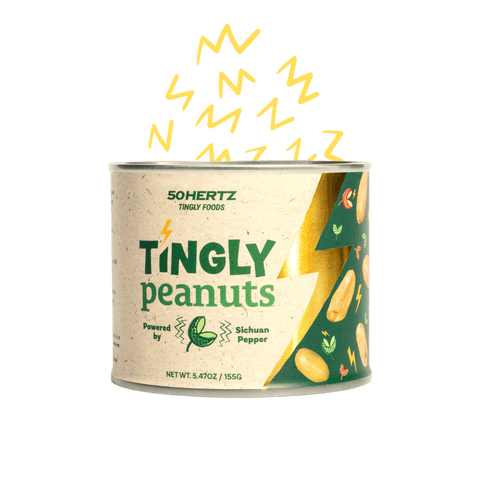
At 50Hertz Tingly Foods, má or the numbing isn’t just a flavor — it’s a philosophy. It’s the electric, numbing thread that runs through everything we create, from our Sichuan pepper–infused peanuts and lemon ginger cookies to our crisp brittles and rich chocolates.
You can even experiment with this magic in your own kitchen using our 100% potent, single-origin Sichuan pepper and oils — farm-sourced and crafted with real ingredients from the spice’s true origin. No fillers. No shortcuts. Just pure, electrifying flavor.
By weaving má into our novel creations, we’re creating a whole new kind of sensory experience — one that’s bold, tingly, and totally unforgettable. Whether you're a chili head looking to add a buzz to your spice rack, a curious foodie, Michelin-starred chef, or someone wondering “why is my mouth buzzing?” — there’s a seat for you at our table.
Because today, spice isn’t just about heat.
It’s about something tingly, numbing, and electric — that full-sensory má-gic only Sichuan pepper can deliver.
Sources:
[1] Bautista, D. M., Sigal, Y. M., & Lumpkin, E. A. (2008). Pungent agents from Szechuan peppers excite sensory neurons by inhibiting two-pore potassium channels. Nature Neuroscience, 11(7), 772–779. https://www.nature.com/articles/nn.2143.epdf
[2] Hagura N, Barber H, Haggard P. 2013 Food vibrations: Asian spice sets lips trembling. Proc R Soc B 280: 20131680. http://dx.doi.org/10.1098/rspb.2013.1680




Commentaires (0)
Il n'y a pas de commentaires pour cet article. Soyez le premier à laisser un message !