

If you’ve ever been to a Chinese New Year dinner — at a family home, restaurant, or office banquet — you probably remember one thing first:
the spread.
 Whole fish glistening with ginger and scallions. Plate after plate of dumplings. Long noodles looping on plates. Sticky rice cakes. Towers of oranges or tangerines. It feels abundant, celebratory, and slightly overwhelming in the best way. Most people start eating before realizing how intentional it all is.
Chinese Lunar New Year — also called Spring Festival (Chūnjié 春节) — centers on the reunion feast known as the New Year’s Eve dinner (niányè fàn 年夜饭). Families travel far and wide to gather, and the menu becomes unusually intentional. Think of it like Christmas dinner in the U.S.: turkey every year, desserts that must appear, families debating ham versus pie. That’s what the holiday tastes like.
Lunar New Year follows the same logic — except the food also speaks. Many dish names carry double meanings. Fish sounds like “surplus.” Rice cake sounds like “rising.” Oranges suggest "luck or success." Even leaving part of a dish untouched can be part of the message.
Celebrations stretch across China and much of Asia, and menus shift by region: dumplings in the north, peppery pork and hot pot in Sichuan, oyster-heavy Cantonese banquets, seafood spreads in Singapore and Malaysia, Tết feasts in Vietnam, and rice-cake soups in Korea.
In this piece, we’re focusing on the most iconic Chinese Lunar New Year foods, each paired with a 50Hertz Note on weaving Sichuan pepper’s aroma and tingle into tradition.
In 2026 — the Year of the Fire Horse — those plates arrive with extra heat and momentum. Here are the foods you’re most likely to see, and what they’re quietly saying.
1) Dumplings — 饺子 (jiǎozi)

Meaning: Wealth & Shared Fortune
Originally a northern China staple, dumplings now appear everywhere during the holiday — from Beijing and Shanghai to Sichuan homes and Chinese-American kitchens where traditions evolve.
Their curved shape resembles ancient silver and gold ingots, linking them to prosperity. Families often gather to fold dozens — sometimes hundreds — turning prep into part of the celebration. Some tuck a coin into one dumpling for extra luck.
Legend has it the more dumplings you eat, the richer you’ll be in the year ahead… which is exactly the kind of superstition nobody argues with at the table.
50Hertz Note:
Steam carries aroma fast — which is why dumplings love bright Sichuan-pepper oils and sharp dipping sauces. That’s what inspired our Tingly Dumpling Dipping Sauce with crushed red huājiāo, chopped peanuts, garlic, ginger, rice vinegar, sesame oil, and chili heat. Perfect with jiǎozi — or any dumplings at all.
2) Whole Fish — 鱼 (yú)

Meaning: Surplus & Abundance
Fish appears at nearly every lunar new year banquet table because 鱼 (yú, fish) sounds like 余 (yú, surplus) in Chinese.
The phrase 年年有余 (niánnián yǒu yú) — “may you have abundance every year” — is also a common saying during Chinese New Year.
Traditionally the fish arrives whole, head and tail intact, and many families leave some uneaten so prosperity carries into the year ahead.
50Hertz Note:
Finish steamed fish with sizzling oil infused with green Sichuan pepper, ginger, and scallion — fragrant and bright without overpowering delicate flesh.
3) Sticky Rice Cake — 年糕 (niángāo)

Meaning: Rising Year to Year
Niángāo plays on sound: 年 means “year,” while gāo (糕) is a homophone with 高 — meaning “high.” Eating it becomes shorthand for hoping life moves upward.
Made from glutinous rice flour and sugar, the cake is chewy and sliceable, perfect for pan-frying or stir-frying later. Some families steam it sweet; others fold it into savory dishes — all carrying the same upward wish.
50Hertz Note:
A pinch of crushed green Sichuan pepper (huājiāo) in caramel or brown-sugar syrup adds citrus lift that keeps sticky rice from feeling heavy.
4) Longevity Noodles — 长寿面 (chángshòu miàn)
 Meaning: Long Life
These noodles are intentionally long and never cut. Breaking them symbolically shortens life, so people serve and slurp carefully.
They appear at birthdays too, but Lunar New Year is prime time for broadcasting health wishes.
50Hertz Note:
Bloom red Sichuan pepper in oil with garlic and scallion, then toss noodles in that fragrant base for richness without weight.
5) Sweet Rice Balls — 汤圆 (tāngyuán)
 Meaning: Reunion & Wholeness
Round foods matter during Lunar New Year, and tāngyuán sounds like tuányuán (团圆), meaning reunion.
Tangyuan are soft, glutinous rice balls typically filled with sweet black sesame, peanut, or red bean paste and served in a light syrup — often gently scented with fresh ginger.
They often appear toward the end of celebrations, when families close things out with something warm and sweet.
50Hertz Note:
Steep a few green peppercorns in ginger syrup for subtle citrus perfume alongside black-sesame filling.
6) Tangerines & Oranges — 橘子 (júzi) / 橙 (chéng)
 Meaning: Luck, Wealth & Success
Citrus piles up on tables and in gift bags because it carries layers of symbolism:
Language: In many Chinese dialects, the names for various citrus fruits echo words for luck or success.
In Mandarin, the word for orange (桔, jú) contains the character for luck (吉, jí), while the pronunciation in Cantonese, 橘 (gwat1) sounds similar to 吉 (gat1), meaning “auspicious.”
In Mandarin, the word for orange (橙, chéng) is pronounced the same as 成 (chéng), meaning “success” or “to achieve.”
Kumquats (金橘, jīn jú) literally include the character for gold (金, jīn), making them especially prized during the holiday.
Seasonality: Tangerines, mandarins, pomelos, kumquats, and other citrus peak in winter — right when the holiday arrives — turning harvest abundance into symbolic prosperity.
Color: The gold-orange color of citrus signals wealth and celebration, especially against red décor.
50Hertz Note:
Inspired by Sichuan flavor pairings, mix citrus zest with sugar or salt and crushed Sichuan pepper (huājiāo), then dust over fruit slices for a bright, gently tingly snack.
7) Eight-Treasure Rice — 八宝饭 (bābǎofàn)
 Meaning: Wealth & Blessings
This glossy sticky-rice dessert is made from glutinous rice and steamed with fillings such as red-bean paste, jujubes, candied fruit, lotus seeds, Job’s tears, and longan. The combination reflects both regional taste and traditional food beliefs, though exact ingredients can still vary by household.
The name comes from its use of eight different toppings — a number long associated in Chinese culture with wealth and abundance because 八 (bā) sounds like 发 (fā), “to prosper” or “to get rich.” Eight-treasure dishes lean into that wordplay: many ingredients, many wishes for the year ahead.
50Hertz Note:
Infuse the syrup or glaze with lightly crushed Sichuan pepper (huājiāo) for floral lift that keeps rich sweets.
8) Peanuts — 花生 (huāshēng)

Meaning: Longevity
Peanuts show up boiled, roasted, candied, or folded into sweets during Lunar New Year, and their symbolism goes deeper than snacks.
The name huāshēng can be read as “giving birth,” which links peanuts to fertility, vitality, and long life — classic Lunar New Year wishes. Their abundance inside a single shell reinforces ideas of continuity and generational growth.
They’re often set out in big communal bowls for snacking during long conversations, card games, and late-night tea sessions — food meant to last as long as the gathering does.
50Hertz Note:
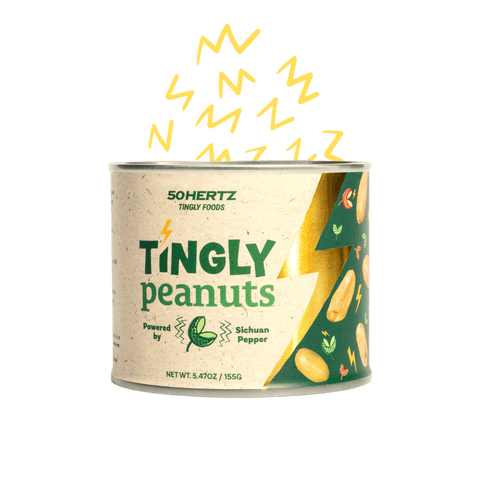
Serve our Tingly Sichuan Pepper Peanuts or Tingly Cashews alongside fresh peanuts for Lunar New Year — their citrusy peppercorn aroma and gentle tingle add a modern contrast to a classic symbolic snack.
9) Sunflower Seeds — 瓜子 (guāzi)
 Meaning: Descendants & Prosperity
If peanuts are for longevity, sunflower seeds are for the future.
Cracking seeds in endless handfuls is practically a Lunar New Year pastime, especially among older relatives. Shells pile up, seeds multiply — a small ritual mirroring families growing.
In Chinese, 子 (zǐ) means both seed and child, turning sunflower seeds into a symbol of descendants and prosperity — a quiet, crunchy wish for generations to come.
50Hertz Note:
Warm store-bought roasted sunflower seeds, then toss with a light dusting of ground Sichuan pepper (huājiāo) and chili for citrusy tingle and smoky crunch — addictive straight from the bowl.
In fact, one of China’s largest snack companies even sells green Sichuan-pepper sunflower seeds, proof that the citrusy málà edge pairs naturally with this New Year staple.

Regional Traditions at the Lunar New Year Table
Of course, even nine symbolic favorites can’t capture the full spread of a Lunar New Year feast.
Just as Christmas traditions vary across Christendom, Chinese New Year tables shift dramatically by region.
Southern banquets often lean seafood-forward — oysters for good fortune, roast duck, shrimp (虾 xiā, which sounds like laughter 哈 hā), steamed chicken (鸡 jī, echoing 吉 jí, “auspicious”), sprawling cold platters, and piles of lettuce (生菜, shēngcài), whose name sounds like “growing wealth.” Cantonese meals can stretch for hours.
These are only the broadest patterns. Traditions vary widely by household and family history.

Sichuan’s Winter Lunar New Year Feast
In Sichuan, winter celebrations skew bold, spicy, and deeply warming — food designed to cut the cold and keep people lingering around the table.

Hot Pot — 火锅 (huǒguō)
A bubbling cauldron set at the center of the table, packed with chilies, aromatics, and numbing Sichuan pepper.
Families cook thin-sliced meats, tofu, mushrooms, and greens on the fly — perfect for long New Year nights, when gathering around one shared pot symbolizes reunion, winter warmth, togetherness, and hopes for abundance in the year ahead.
Cured Pork — 腊肉 (làròu)
Salted and air-dried slabs of pork hung through winter months, then sliced and stir-fried or steamed.
Smoky and concentrated, it arrives at Lunar New Year as proof of careful winter preparation — an edible sign of foresight, stored wealth, and a household entering spring with plenty to spare.
Wind-Dried Sausage — 香肠 (xiāngcháng)
Sweet-savory pork sausages are cured in cold air, often scented with rice wine and spice, then sliced into clay-pot rice or arranged on celebratory platters.
Like cured pork, they’re made weeks in advance and unveiled for the holiday, their round cross-sections echoing ideas of wholeness and continuity as one year gives way to the next.
Crispy Pork — 小酥肉 (xiǎo sū ròu)
Thin strips of pork battered and fried until crackly, sometimes finished in broth.
Rich yet light and deeply satisfying, it shows up at Lunar New Year banquets because frying is festive, labor-intensive, and indulgent — the kind of treatment reserved for a once-a-year meal meant to honor guests and mark a fresh beginning.
Why Huājiāo Belongs on the Lunar New Year Table

What unites many of these dishes is huājiāo — Sichuan pepper — used not only for flavor, but for symbolism.
For centuries, Sichuan pepper's clustered pods have been associated with fertility and abundance. The branching stems and bead-like berries suggest multiplication — a visual symbol for prosperity, descendants, and a household that flourishes.
On one of Yao’s sourcing trips for 50Hertz, we encountered 娃娃椒 (wáwá jiāo) — “baby Sichuan pepper” — a prized subtype grown in select mountain regions. Behind the larger crimson husks, tiny secondary berries cluster densely, doubling the sense of natural abundance and reinforcing its long-standing symbolism.
Seasonality deepens the fit. Harvested in late summer and autumn, Sichuan pepper retains its citrus-bright aroma through winter — just as Lunar New Year feasts begin. Its red color mirrors the lanterns and red envelopes already filling homes.
And then there’s the sensation: má (麻) — the gentle electric tingle that wakes up the palate. Lunar New Year marks renewal and fresh beginnings. Few ingredients make you feel that awakening so immediately.
Sichuan pepper doesn’t just season the feast.
It embodies it.
A Feast That Speaks
From dumplings shaped like ingots to citrus glowing on the table, Lunar New Year dishes are never just food — they’re wishes for the new year made edible.
Across regions and generations, the flavors shift, but the message stays constant: abundance, longevity, reunion, and momentum for the year ahead.
So when you reach for one more dumpling or crack another handful of seeds, remember — you’re not just eating dinner.
You’re welcoming the lunar lunar new year, one symbolic bite at a time.




Commentaires (0)
Il n'y a pas de commentaires pour cet article. Soyez le premier à laisser un message !