

What happens when you combine Italian tagliatelle with the flavors of Sichuan's mapo tofu? Or drizzle gelatinous Chinese wood ear mushrooms with olive oil, white wine vinegar, and parsley? And who would think to pair tofu with avocado?
These are some of the delightful surprises in Five Tastes: Delicious Recipes for Chinese Flavors, the new cookbook from Fuchsia Dunlop, one of the English-speaking world's foremost authorities on Chinese cuisine.
After decades faithfully documenting Chinese culinary traditions, Dunlop has written something more personal. In Five Tastes, she draws on everything she has learned to experiment with familiar ingredients, adapting Chinese flavors to everyday cooking while inviting us to do the same.

Fuchsia Dunlop: A Life in Chinese Food

Dunlop was the first Westerner to train as a chef at the Sichuan Higher Institute of Cuisine in Chengdu. Since then, she has explored China's seemingly endless culinary traditions, from Hunan in Revolutionary Chinese Cookbook to Jiangnan, the Lower Yangtze region that includes Shanghai, in Land of Fish and Rice.
The Food of Sichuan is naturally a favorite at 50Hertz, while Invitation to a Banquet is akin to a bible for understanding the history, culture, and philosophy of Chinese food. Together, her books reveal the extraordinary breadth and depth of Chinese cuisine, as well as her unending curiosity about the people and cultures behind it.

The Song dynasty poet Su Shi once wrote:
不识庐山真面目,只缘身在此山中。
“We cannot see Mount Lu's true face, because we are standing within the mountain.”
I think of these lines when reading Dunlop. Her outsider's perspective, combined with decades of immersion in Chinese culture, helps her notice things that even some Chinese people might take for granted. She's cooked alongside chefs and observed how people eat and talk about food.
For many of us in the West, it's hard to understand why a slimy, slippery, nearly flavorless sea cucumber can command a small fortune. Its appeal lies in its gelatinous texture, ability to absorb rich sauces, and associations with health and prosperity. Duck tongues offer the pleasure of nibbling tender flesh from cartilage; goose intestines are swished through Sichuan hot pot for their springy crunch. Dunlop helps us appreciate these ingredients for everything from mouthfeel and culinary technique to cultural associations and centuries of tradition.
In Five Tastes, she brings this knowledge into our kitchens. Yet her recipes are practical, grouped into familiar categories from tofu and fish to vegetables, noodles, dumplings, and sweets. The book stays true to Chinese flavors but isn't afraid to experiment with Western cooking techniques, unconventional ingredients, and unexpected combinations.
Learning the Language of Chinese Flavor

What I love about Five Tastes is how carefully Dunlop first builds our understanding of Chinese cooking, beginning with five traditional tastes: sweet, sour, bitter, pungent, and salty.
But these are only the beginning. She introduces xiān (鲜), an ancient concept of savoriness that overlaps with umami but also suggests freshness; má (麻), the tingling, citrusy numbness of Sichuan pepper; and xiāng (香), the fragrance of roasted and aromatic foods. Dunlop traces xiāng to the scent of millet, a sacred grain used in ancient rituals, revealing how deeply the language of flavor is rooted in Chinese history.
One of my favorite concepts is qīngdàn (清淡), often translated as light or bland, though Dunlop explains it evokes gentleness, tranquility, and comfort. Chinese cooking has long emphasized health and balance: a good meal should offer well-being as well as excitement. Even in spicy Sichuan, fiery dishes are often accompanied by plain rice and mild broth. Dunlop helped me reconsider something I'd long found puzzling: why some Chinese soups seem so bland. Their blandness, I now appreciate, is the point, soothing the palate alongside richer dishes.

She also explores běnwèi (本味), the natural flavor of ingredients, and tiáowèi (调味), the art of seasoning. These ideas challenge the misconception that Chinese cooking is all heavy sauces. Some of its most prized dishes showcase exceptional ingredients, while seasonality, provenance, and quality have mattered to Chinese cooks for centuries—values Western audiences often associate more readily with French or Japanese cuisine.
Inside the Chinese Pantry
From natural flavors, Dunlop turns to the seasonings that transform them. Even soy sauce has surprising complexity: light and dark varieties serve different purposes, while fermented tofu, black beans, and preserved vegetables contribute their own flavors.
Fermentation is central to this pantry. Dunlop introduces qū (曲), traditional fermentation starters containing molds, yeasts, and bacteria, and explains how they help develop the complex flavors of Chinese seasonings.

Images: Five varieties of qū (曲), fermentation starters used to make baijiu, rice wine, soy sauce, vinegar, and other fermented foods.
Even vinegar has a geography, from the aromatic Chinkiang vinegar of Jiangsu to Shanxi's aged varieties. Sichuan's Pixian chili bean paste owes its depth to fermented fava beans, chilies, and time. Behind these condiments lie centuries of craftsmanship and regional tradition.
Yet Dunlop makes the pantry surprisingly manageable. A single shopping trip to Chinatown should cover most of the essentials, and she's flexible about substitutions. Can't find Sichuan pickled chilies? More readily available Indonesian sambal oelek will do.
She then explores fùhéwèi (复合味), or compound flavors. Found throughout Chinese cooking, these combinations reach extraordinary complexity in Sichuan, where yúxiāng (鱼香), fish fragrant, and guàiwèi (怪味), strange flavor, are just two examples.
That variety may help explain Sichuan's popularity: it leads regional cuisines in restaurant numbers and ranked first in a study of social-media food preferences. Its adaptable flavors have helped it spread far beyond Sichuan. Dunlop explores these combinations in The Food of Sichuan, which inspired our own guide to Sichuan flavors.
Knowing the Rules, Then Making Them Your Own
In Five Tastes, Dunlop quotes the legendary chef Yi Yin, who is said to have advised King Tang on cooking and, by analogy, governing. He compares the subtle transformations inside a cooking cauldron to the interplay of yin and yang and the passing seasons. The ideal food, he explains, should be:
“Sweet but not cloying, sour but not bitingly so, salty but not deadening, pungent but not too fierce, mild but not insipid, and richly fat without being greasy.”
Dunlop jokes that if she ever got a tattoo, it might be some of Yi Yin's words. I understand the temptation. What I especially love about Five Tastes is how she draws on these ancient principles while experimenting freely with traditions she understands so intimately.
Take Overnight Fish Fragrant Eggplants, her variation on yúxiāng qiézi (鱼香茄子), a Sichuan classic so ubiquitous across China that I ate it constantly while studying abroad in Beijing, assuming it was a local specialty. Dunlop roasts the eggplant in an oven, still uncommon in Chinese homes, rather than deep-frying it, then lets it soak up a garlicky, sweet-sour chili sauce overnight. A restaurant favorite becomes an easy make-ahead dish.

Image: Yúxiāng qiézi (鱼香茄子), or fish-fragrant eggplant, transforms an affordable, everyday vegetable into a dish of wonderfully complex flavors.
Her Tagliatelle with Mapo Ragù goes further. Inspired by Italian cookbook author Marcella Hazan, she simmers meat with Sichuan chili bean paste, fermented black beans, and Shaoxing wine, finishing the pasta with roasted Sichuan pepper instead of Parmesan.
She pairs avocado with tofu in two playful inventions: a salad with tomato and sesame oil, and a sour-hot Sichuan variation with an optional preserved duck egg. Avocado is hardly a traditional Chinese ingredient, but neither was the tomato, whose Chinese name, fānqié (番茄), literally means “barbarian eggplant,” as Dunlop points out. Yet today, tomato and egg stir-fry (fānqié chǎo jīdàn, 番茄炒鸡蛋) is one of China's most beloved comfort foods. It's a reminder of how once-foreign ingredients can become inseparable from a culinary tradition.
In Takeout Sweet and Sour Pork, she revisits the British Chinese food of her childhood with affection rather than dismissing it as inauthentic.
Two Five Tastes Recipes at 50Hertz
Fuchsia has kindly given us permission to share two recipes from the book, brought to life by our collaborating chef Doug Heilman.
First is Green Beans with Strange Flavor Sauce, featuring guàiwèi (怪味). Sesame paste, soy sauce, vinegar, sugar, chili oil, and Sichuan pepper create a dressing that's nutty, tangy, sweet, spicy, and tingly. Inspired by Indonesian gado gado and Lebanese vegetables with tahini, the versatile sauce works just as well on roasted cauliflower, broccoli, barbecued meats, or blanched spinach. Dunlop even suggests spreading it on buttered toast and crumpets!

Next is Lime and Sichuan Pepper Posset, a British cream dessert flavored with lime and green Sichuan pepper. It's an inspired pairing that demonstrates something we've always believed at 50Hertz: Sichuan pepper belongs in desserts and even cocktails, just as much as savory cooking.

Celebrating Fuchsia's Five Tastes Book Tour
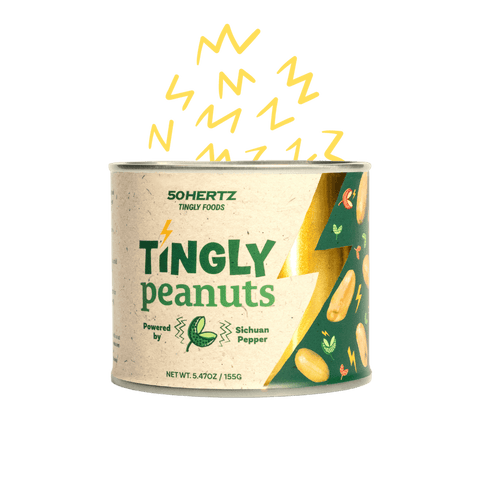
In 2023, 50Hertz supported Fuchsia's U.S. tour for Invitation to a Banquet, sharing our Tingly Sichuan Pepper Peanuts with guests. We're excited to support her Five Tastes tour, too, providing our tingly snacks at several events across the U.S.
On October 19, our head of operations, Ingrid, attended a special banquet with Fuchsia at Chang Chang restaurant in Washington, DC.

 Photos: Scenes from the October 19 banquet celebrating Fuchsia Dunlop’s Five Tastes at Chang Chang in Washington, DC, featuring 50Hertz’s Ingrid, Fuchsia, and chef Peter Chang.
Fuchsia's tour continues in San Francisco on October 24, Los Angeles on October 27, Portland on October 28, Ann Arbor on October 30, and New York on November 3. Find dates and tickets on her events page.
We're also excited to announce that signed copies of Five Tastes will soon be available through 50Hertz. Stay tuned!
Five Tastes is a book to cook from, but also to read and return to. Dunlop gives us the language to understand Chinese flavors, then the confidence to play with them. Understanding a tradition, she shows, doesn't mean being confined by it.
Whether you're discovering Chinese cooking for the first time or have been exploring its flavors for years, Five Tastes deserves a place on your bookshelf.
Explore Five Tastes by Fuchsia Dunlop



Commentaires (0)
Il n'y a pas de commentaires pour cet article. Soyez le premier à laisser un message !