
The first time a brewer reaches for Sichuan pepper, it’s usually not part of a plan. It’s often out of curiosity.
They know hops: bright, bitter, tropical. They’ve played with fruit, fermentation, barrels, botanicals.
Then something unfamiliar shows up. Aromatic, citrusy, slightly electric. And everything shifts.
They taste it, pause, and almost immediately ask: what just happened?
Because Sichuan pepper isn’t just flavor. It’s a sensation.
And that’s why they keep coming back to it.
It Doesn’t Just Add Flavor—It Changes the Drinking Experience
 Image: Wild West Brewing (Chengdu, China) — American-style craft brewery bringing classic styles to Chengdu, Sichuan, including a Sichuan peppercorn witbier (“China White”).
On paper, Sichuan pepper reads as subtle: citrus, floral, maybe a touch of pine. Nothing that suggests it could carry a beer.
But that’s not where its impact lies.
Sichuan pepper creates a light, vibrating tingle on the palate. Not heat like chili. Not cooling like mint. Something entirely different.
That sensation comes from a compound called hydroxy-alpha-sanshool. It interacts with sensory nerves in the mouth, triggering signals your brain interprets as vibration. Not flavor, but touch.
Brewers are already familiar with this layer of sensation. Carbonation does something similar. It activates the same broader nerve system, giving beer its bite and lift.
Sichuan pepper works differently. Instead of sharpness, it creates a gentle, sustained vibration that moves across the palate. That subtle tingling resets the palate while amplifying aromatics, especially citrus, hops, and fruit.
Most ingredients add weight: sweetness, bitterness, body. Sichuan pepper does the opposite. It lifts the beer, keeps the finish from flattening, and makes each sip feel distinct.
It doesn’t overwhelm the palate. It keeps it engaged.
And that’s what pulls you back in for another sip.
The First Time We Saw It Work

We didn’t start with beer. We were working with chefs and chocolatiers—like Monica and Tom at Goodnow Farms and Christine Doerr at NeoCocoa—people already pushing the edges of flavor.
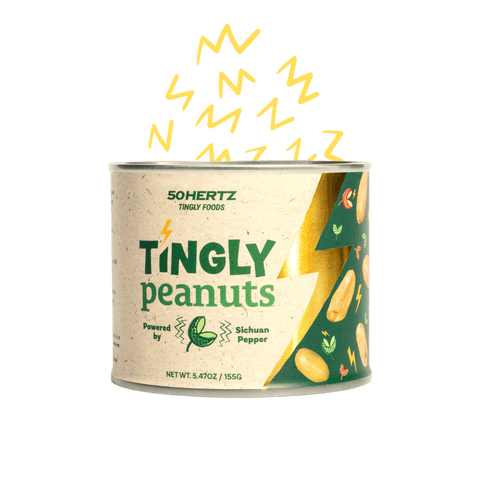
Lost Generation Brewery and Taproom in Washington DC was one of the first to stock our tingly peanuts. Behind the bar, next to a pint, the reaction was immediate—the tingle didn’t just add flavor, it changed the way people experienced the drink.
So when Lost Generation and Bluejacket began developing a witbier for an AAPI Stop Asian Hate community project, we joined in—bringing Sichuan pepper into the center of the beer.


Images: Anne Choe, General Manager and Owner of Lost Generation Brewing Company, adding 50Hertz Sichuan pepper to the brew kettle — where aroma becomes sensation.
The result was Tiger Spirit.


A witbier brewed with Sichuan peppercorn, chrysanthemum, orange peel, and coriander—soft, bright, and food-friendly, with the tingle woven directly into the drinking experience.
The project supported Chefs Stopping AAPI Hate, with proceeds going toward AAPI communities.
The name Tiger Spirit came from a line in The Joy Luck Club by Amy Tan—a writer we’ve long admired and a friend of 50Hertz.
“I will use this sharp pain to penetrate my daughter’s tough skin and cut her tiger spirit loose… because this is the way a mother loves her daughter.” – The Joy Luck Club
Sharp. Awakening. Emotional. The same feeling as the tingle.
Even the can design carried that idea. Jared, head brewer and owner of Lost Generation Brewery and Taproom, chose the tiger lily — native to Asia, now thriving across North America — as a quiet reflection of how Asian American communities have taken root and flourished here.

Image: Amy Tan with Tiger Spirit — a full-circle moment for a beer rooted in her words.
That idea of sharpness as release mirrors what Sichuan pepper does physically. It creates a brief tension that opens everything up.
You could watch it happen in real time. People would take a sip, pause, then go back for another, not because it was intense, but because it was intriguing.
That was the turning point for us.
It made something clear: this wasn’t just a novel ingredient. It was a tool.
It’s a Tool Brewers Already Understand — Just Without a Name
Brewers already think in terms of balance. Bitterness against sweetness. Aroma against body. Finish against aftertaste.
What Sichuan pepper introduces is something slightly different: control over how a beer evolves across multiple sips.
That gentle tingling keeps the finish from falling flat. It reduces palate fatigue in hop-heavy beers. It extends the perception of brightness.
In practical terms, your IPA drinks cleaner. Your saison feels more lifted. Your fruit beer pops without needing more sugar or acidity.
It doesn’t replace what you’re doing.
It makes it work better.
When Flavor Becomes a Moment

What surprised us most was how naturally Sichuan pepper lends itself to concept-driven beers — not as a gimmick, but as a way to express something more intentional.
We saw this in a collaboration with Bluejacket on a saison called Briefly Gorgeous, brewed with yuzu, Buddha’s hand, and Sichuan pepper. The beer was a tribute to Ocean Vuong’s On Earth We're Briefly Gorgeous — not just the title, but the way the book moves through memory.
In the book, Ocean Vuong writes in fragments. Moments with his mother, his first love, small scenes that feel intensely present and then slip away. Nothing is held for long, but that is what gives it weight.
“To be gorgeous… is to be gorgeous only briefly.”

That idea maps directly onto Sichuan pepper.
The sensation does not linger. It arrives, heightens everything around it, and disappears, sometimes before you can fully name it. In that brief window, the entire drink feels sharper, more alive, more defined.
It is not about building intensity over time. It is about creating a moment that is felt completely, and then gone.
The beer does not just reference the book. It behaves like it.
The World of Sichuan Pepper Beers
Around the same time we were exploring it, we started noticing something.
Sichuan pepper was not just working in our collaborations. It was beginning to show up across very different brewing contexts.

In New York, Brooklyn Brewery, a foundational force in the American craft beer movement, brewed Electric Gold with 50Hertz’s Sichuan peppers. The project was overseen by Garrett Oliver, master brewer and editor of The Oxford Companion to Beer.
 Image: Yao with Garrett Oliver — one of the minds that helped shape modern craft beer, and a reminder that great ideas (and great beer) always come back to people.
Seeing an ingredient like this move through that level of brewing made it clear that this was not a niche idea.
A Few Sightings from Around the World
And once you begin to notice it, you start seeing it more widely:
-
Burial Beer Co. in Ashville, North Carolina

-
Young Master Brewery in Hong Kong

-
Wild West Brewing in Chengdu

-
Taiwan Head Brewers, where 青花椒啤酒 translates to Sichuan peppercorn beer

-
Edmund’s Oast Brewing Company, Charleston, South Carolina

-
Homebrewers experimenting with recipes like Blade Runner Szechuan Pepper Beer

Each example differs in style and context, spanning different parts of the world, but they converge on a similar effect. There is no single origin point, just a shared instinct.
The beers do not simply taste bright. They feel alive.
What You Start to Notice
Over time, Sichuan pepper stops feeling like an experiment and becomes something you recognize. A brightness that isn’t just citrus. A finish that doesn’t settle. A drinking experience that resets itself as you move through the glass.
The effect isn’t about intensity. It’s about movement. Hops feel sharper. Aromatics open up. The finish stays active instead of closing off. Sometimes it’s subtle—until halfway through the glass, when you realize you’ve been drinking faster, not because it’s lighter, but because it keeps shifting.
There are many ways to make a beer more intense. That’s not always what makes it memorable. Sometimes it’s the opposite. A sensation that arrives, changes everything around it, and disappears before you can fully name it.
Some flavors stay with you. Others pass through you—and in doing so, change how you remember them.
If you’re interested in bringing Sichuan pepper into your bar or brewery, we’d love to explore it with you. Every application is different. That’s part of what makes it interesting.
[1323 words]



Commentaires (0)
Il n'y a pas de commentaires pour cet article. Soyez le premier à laisser un message !