
Kung Pao chicken is one of the most recognizable Chinese dishes in the world.
Its reach is so global that when German Chancellor Angela Merkel visited Chengdu in 2014, her itinerary included a stop at a Sichuan restaurant to watch a chef make the dish.
But the Kung Pao most people know outside China is only one version of it.
In Sichuan, the dish is usually sharper, less sweet, and much less saucy, with dried chilis, vinegar, peanuts, and just enough Sichuan pepper to make your lips tingle.
The dish's history also doesn't fit neatly into a simple origin story.
Kung Pao chicken is tied to a Qing Dynasty official whose life took him through Guizhou, Shandong, and Sichuan — three places that each have their own claims to inventing the dish.
So where did Kung Pao chicken actually come from?
Who Was Kung Pao?

The man behind the name of the dish was Ding Baozhen, a Qing Dynasty official born in Guizhou in 1820. He later served as governor of Shandong and then Sichuan provinces.
After his death, Ding was given the honorary title "Grand Tutor to the Crown Prince," commonly shortened to "Gongbao" in Chinese. That title "Gongbao" became the name of the dish.
"Kung Pao," as it's still written on many Chinese restaurant menus today, is simply an older English spelling of Gongbao.
The full Chinese name is "Gongbao Jiding" (宫保鸡丁). Ji means chicken, while ding means small diced pieces.
The word ding (丁) was also Ding Baozhen's last name, adding a bit of wordplay to the dish's name.
Where and How Was Kung Pao Chicken Invented?

Figure: Map of China highlighting Guizhou, Shandong, and Sichuan, the three provinces linked to the development of Kung Pao chicken.
The simple story is that Ding loved chicken and the dish was created for him. The real story is more complicated.
Guizhou claims the story starts there because Ding was born in the province and was said to enjoy its spicy diced chicken. The Guizhou version still uses ciba chili and has a distinctly sour, salty-spicy flavor.
In Shandong, where Ding later served as governor, he is said to have adapted a local diced chicken dish. Shandong versions often use chicken thigh, bamboo shoots, or water chestnuts and rely on fast, high-heat stir-frying.
Sichuan is where Kung Pao took its most famous form. One legend says a Chengdu banquet dish was named Gongbao Chicken after Ding's official title. Sichuan cooks developed the familiar mix of dried chilis, Sichuan pepper, peanuts, and a sweet-sour flavor.
Another account says Sichuan officials later presented the dish to the emperor as tribute helping to spread the dish.
So Kung Pao may have evolved with Ding's travels: rooted in Guizhou, developed in Shandong, and transformed in Sichuan.
What Makes Sichuan Kung Pao Different?

The Sichuan version is arguably the most famous form of Kung Pao chicken, and it uses a surprisingly short list of ingredients: diced chicken, dried chilis, peanuts, scallions, ginger, garlic, sugar, vinegar, soy sauce, and Sichuan pepper. For a great example of the traditional approach, see this gongbao chicken recipe from our friends at The Mala Market.
The chicken is cooked quickly over high heat, and the sauce should coat it rather than pool at the bottom of the plate.
The flavor isn't simply "sweet and spicy." A good Kung Pao balances sweetness, vinegar, chili heat, salt, crunch, and a light tingle from Sichuan pepper.
That balance is essential to the dish.
The "Lychee Flavor" That Has No Lychee

One of the more surprising things about Sichuan Kung Pao is that its flavor is traditionally described as "lychee flavor," or lizhi wei (荔枝味).
However, there is no lychee in the dish.
The term refers to a sweet-and-sour balance created with sugar and vinegar, layered with chili heat and Sichuan pepper.
A traditional description says you should first notice a little heat and numbness, then sweetness, followed by a slight sourness.
In other words, Kung Pao shouldn't just taste sweet, and it shouldn't just taste hot.
Why Sichuan Pepper Matters

Sichuan pepper, or huajiao (花椒), is one of the biggest differences between Sichuan Kung Pao and many versions served outside China.
Despite its English name, Sichuan pepper isn't actually a pepper or a chili. It creates the citrusy, mouth-tingling sensation that makes Sichuan food so distinctive.
In Kung Pao, the goal is a light tingle and aroma that works with the chilis, vinegar, sweetness, and peanuts — not to overwhelm the dish.
50Hertz's Red Sichuan Pepper is the classic choice for Kung Pao, while green Sichuan pepper gives you a brighter, more citrusy flavor.
With either one, freshness matters. That's why 50Hertz sells Sichuan pepper whole rather than pre-ground, keeping its aromatic oils protected until you're ready to crush or grind it.
Were Peanuts Always Part of Kung Pao?

Peanuts seem inseparable from Kung Pao today, but apparently they weren't always there.
Some accounts say earlier versions served in Sichuan's official circles didn't necessarily include them. Peanuts became more common as the dish spread into public restaurants.
In the U.S., you'll also sometimes find Kung Pao made with cashews instead of peanuts. Cashews were already a familiar ingredient in American Chinese cooking, and their richer, buttery flavor made them a natural variation. But in Sichuan, peanuts remain the classic choice.

For purists, the peanuts deserve a little attention of their own: start with raw peanuts and fry or toast them until crisp and golden. Some cooks remove the skins for a cleaner look and texture; others leave them on for a more rustic crunch.
Today, peanuts and Sichuan pepper are a natural pairing of their own: crunchy, nutty, citrusy, and tingly.
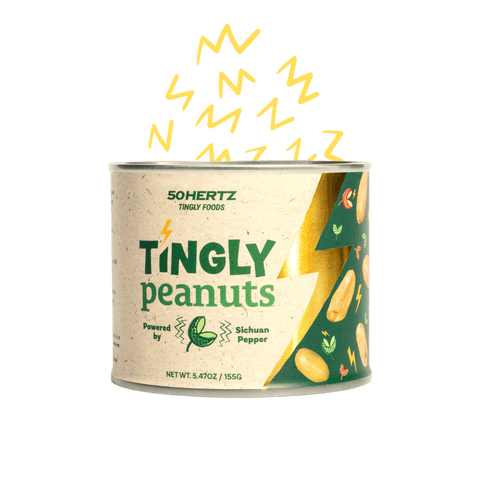
That same combination inspired 50Hertz's Tingly Sichuan Pepper Peanuts, which turn that classic pairing into a snack you can eat straight from the bag, or toss into your own Kung Pao chicken for extra crunch and tingle.
How Kung Pao Traveled the World
As Kung Pao traveled, it kept changing.
In the United States, Kung Pao often evolved into a sweeter, saucier dish with larger chunks of chicken and vegetables like bell peppers, celery, or zucchini, while Sichuan pepper was sometimes left out entirely.
Cooks also began applying the same Kung Pao flavor idea to completely different proteins: beef, pork, shrimp, tofu, scallops, and even rabbit, and more.

Image: From chicken to beef, pork, shrimp, and tofu, Kung Pao shows why Sichuan flavors travel so well: the same balance of chilis, vinegar, sweetness, peanuts, and Sichuan pepper can work with all kinds of ingredients.
Some Chinese sources now count more than 100 Kung Pao variations.
That adaptability may be part of why the dish became so global in the first place.
So What Is the "Real" Kung Pao Chicken?
Maybe there isn't just one.
Kung Pao changed as it moved through Guizhou, Shandong, and Sichuan, then changed again as it traveled around the world.
But it was the Sichuan version — with dried chilis, peanuts, sweet and sour, and the distinctive tingle of Sichuan pepper — that became the global standard.
That balance is what makes Sichuan Kung Pao so recognizable, even as cooks around the world swap in different vegetables, nuts, or proteins.
If you're making it at home, good Sichuan pepper is one of the easiest ways to get closer to that flavor. Our Red and Green Sichuan Pepper bring the citrusy aroma and tingle that make the Sichuan version distinct.
You don't need much.
But without it, you're missing one of the things that makes Sichuan Kung Pao taste like Kung Pao!




Commentaires (0)
Il n'y a pas de commentaires pour cet article. Soyez le premier à laisser un message !