

Americans are no strangers to seasoned nuts.
Honey-roasted peanuts, rosemary-and-sea-salt cashews, caramel pecans — we’ve been seasoning our snacks for a very long time.
But there’s a much bigger world of spiced nuts beyond the familiar favorites.
In the Philippines, peanuts come loaded with crispy fried garlic. German Christmas markets perfume the air with cinnamon-sugar almonds. Nigerians grind peanuts, press out their oil, then turn what’s left into an entirely new snack. And in China, Sichuan pepper can make a handful of peanuts tingle on your tongue.
We’ve also bent the definition of “nut” for a couple of snacks that were simply too interesting to leave out.
Here are eight worth knowing.
1. Wasabi Peas (Wasabi Mame) — Japan
 Yes, we're immediately breaking our own rule. Peas aren't nuts, but wasabi peas are too good to leave out — and they've become a familiar sight in American snack aisles and pantries.
Real wasabi is a Japanese plant in the same family as horseradish and mustard. Peas are first roasted or fried, then covered in a crunchy wasabi-flavored coating.
What makes wasabi peas so much fun is the sudden sinus-clearing punch. Unlike capsaicin heat, which builds and lingers on the tongue, wasabi’s sharp kick hits quickly through the nose and sinuses, then fades.
However, because real wasabi is expensive, most packaged wasabi peas actually get their signature kick from horseradish and mustard instead.
2. Garlic Fried Peanuts (Adobong Mani) – Philippines
 Adobong mani is a popular Filipino snack made by frying peanuts with loads of garlic and salt. Spicy versions often add hot chiles.
The name roughly means “seasoned peanuts” — adobo comes from the Spanish adobar, meaning “to season” or “marinate.” Despite the name, these do not taste like the soy-and-vinegar Filipino adobo many of us may be familiar with.
For many Filipinos, adobong mani is comfort food — an inexpensive street snack sold by vendors on busy sidewalks.
And those crispy golden pieces of fried garlic might be the best part.
3. Fried Peanut Snack (Kuli-Kuli) — Nigeria
 People in Nigeria don’t just season peanuts. They transform them into something completely different.
Kuli-kuli, a popular snack in northern Nigeria, starts with roasted peanuts ground into a paste. Most of the oil is pressed out, and what's left is mixed with salt, chile, ginger, and other spices. It's then shaped into sticks, discs, balls, or rings and fried until crisp.
What starts as what's left after making peanut oil becomes a snack in its own right.
The result is crunchy, deeply peanutty, and almost unrecognizable from the peanuts it started as.
4. Sichuan Pepper Peanuts (Mala Huasheng) — China
 Málà huasheng are crunchy peanuts seasoned with chile and Sichuan pepper — a classic combination of heat and mouth-tingling buzz.
That buzz comes from má (麻), the numbing, tingling sensation caused by natural compounds in Sichuan pepper called sanshools. Combine it with là (辣), or chile heat, and you get málà (麻辣), literally “numbing and spicy.”
Peanuts also have a long tradition as a seasoned snack in China, from crunchy málà peanuts to five-spice boiled peanuts (wuxiang huashengmi), simmered with aromatics like cinnamon, Sichuan pepper, fennel, ginger, and cloves.
Chinese peanuts, especially those from Kaifeng, are prized for being especially plump and crunchy — often with a crisper bite than the peanuts Americans may be used to.
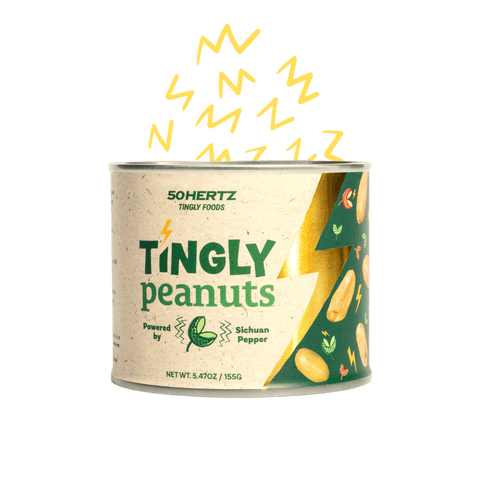
That's exactly what inspired our Tingly Sichuan Pepper Peanuts at 50Hertz. They're our take on one of China's most iconic seasoned peanut traditions.
5. Crushed Nuts & Spices (Dukkah) — Egypt
 Photo credit: By Sheri Wetherell - Flickr, CC BY 2.0, https://commons.wikimedia.org/w/index.php?curid=59633307
Most foods on this list are nuts coated in spices. Dukkah does the opposite by making the nuts part of the seasoning itself.
Dukkah is an Egyptian blend of toasted nuts, seeds, and spices, with recipes varying from family to family. Common ingredients include hazelnuts or almonds, sesame seeds, coriander, cumin, salt, and black pepper.
The mixture is left slightly coarse instead of being ground into a fine powder, so every bite is a little different. You might get a big piece of hazelnut in one bite, then more sesame or coriander in the next.
One of the simplest ways to enjoy it is also one of the best: dip bread in olive oil, then into dukkah.
6. Candied Almonds (Gebrannte Mandeln) — Germany
 Walk through a German Christmas market or fair and you'll probably smell these before you see them.
Gebrannte Mandeln are almonds cooked with sugar, cinnamon, and often vanilla until they develop a crunchy caramelized coating.
As they cook, the sugar first crystallizes around the almonds, then starts to caramelize, creating their rough, crunchy shell. At traditional market stands, they're often made fresh and served warm in paper cones.
While many spiced nuts on this list go savory or hot, Germany goes sweet with plenty of sugar and cinnamon.
7. Japanese Peanuts (Cacahuates Japoneses) — Mexico

Despite the name, Japanese peanuts are actually Mexican.
Cacahuates japoneses are peanuts wrapped in a crunchy, savory-sweet shell of wheat flour, soy sauce, and seasonings, then fried or roasted.
Their story begins in 1940s Mexico City with Japanese immigrant Yoshihei Nakatani. Missing snacks from Japan, he created his own coated peanut using ingredients available in Mexico. It caught on, eventually becoming a familiar snack across the country.
Unlike most nuts on this list, which are simply seasoned on the outside, cacahuates japoneses encase the peanut in an entire crunchy shell.
Similar flour-coated peanuts can be found around the world — including yupi huasheng in China, krikri in Lebanon, and, amusingly, “American peanuts” in Israel.
8. Fried Almonds (Almendras Fritas) — Spain
 After wasabi, garlic, chile, cumin, cinnamon, and Sichuan pepper, Spain keeps things relatively simple.
Almendras fritas are almonds fried in olive oil and finished with salt. They're commonly served as a tapa or snack with drinks.
Spain’s famous Marcona almonds are especially well suited to this treatment. Rounder and plumper than the California almonds most Americans are familiar with, they have a softer, almost macadamia-like texture and a naturally sweet, buttery flavor.
There isn't much hiding behind heavy seasoning here. Good almonds, olive oil, and salt do most of the work.
It's a reminder that making nuts more interesting doesn't always mean adding more spices. Sometimes the simplest preparation is enough.
There’s More Than One Way to Season a Nut
Garlic, wasabi, cinnamon, cumin, chile, sugar, salt — around the world, people have found countless ways to turn a simple nut into something much more interesting.
And then there’s Sichuan pepper, which doesn’t just add flavor. It adds a feeling.
If you haven’t experienced the má tingle yet, try our 50Hertz Tingly Sichuan Pepper Peanuts or Tingly Cashews and see why we can’t stop putting Sichuan pepper on nuts.




Commentaires (0)
Il n'y a pas de commentaires pour cet article. Soyez le premier à laisser un message !