

It starts with a tingle — a curious spark that dances across your lips and lights up your tongue. Bright as citrus, warm as spice, Sichuan pepper doesn’t just season food — it rewires your senses.
That electric buzz comes in two forms. Red Sichuan pepper (hóng huājiāo 红花椒, Zanthoxylum bungeanum) is mellow, floral, and deep — the soulful warmth of Sichuan cuisine.
Green Sichuan pepper (qīng huājiāo 青花椒, Zanthoxylum armatum) is sharp, bright, and electric — a lively contrast.
They aren’t ripe and unripe stages of one fruit, but two distinct species, each with its own terroir, history, and role in the kitchen. Both belong to the Zanthoxylum genus in the citrus family, a sprawling clan of over 250 species — with at least 21 native to China.
What you’re tasting isn’t the seed but the papery husk — the fragrant shell that carries that unmistakable má (numbing) magic.
Let’s explore how these two varieties differ — and how each can transform your cooking.

Image: Quick snapshot of the profile differences between red and green.
Red Sichuan Pepper

Red Sichuan pepper has been used in Chinese cooking for thousands of years — long before chili peppers arrived from the Americas in the 1500s. Archaeologists have traced it back as far as 6300 BCE, making it one of East Asia’s oldest spices.
This is the variety most people outside China know. It’s the backbone of Sichuan cuisine’s iconic málà (麻辣) flavor — the numbing, spicy kick in dishes like Mapo tofu, hotpot, and chili oil. Red peppercorns hold up well to heat and long cooking, which makes them perfect for braises, sauces, and infusions.
Flavor-wise, red Sichuan pepper is the classic. Warm, floral, and woodsy, with notes of rose, orange peel, and toasted spice. Its numbing effect builds slowly and lingers, giving it a round, mellow character compared to the sharper green variety.

Selecting the Best Quality Red
High-quality red Sichuan peppers are large, with husks that split open like plum blossoms — hence the name huājiāo (花椒), or “flower pepper.” The best grades are free of black seeds and packed with aromatic oil. The earliest harvests, when most peppers show that distinctive blossom shape, are considered the highest quality.

Photo caption: We at 50Hertz sift out these black seeds with machines and by hand.
High-quality red Sichuan pepper is also rosy but not unnaturally bright red in color, with lesser quality products appearing more dark brown.

Photo caption: What we offer (left) vs. what’s on the U.S. market typically (right) -Photo credit: The Mala Market
Hanyuan County in western Sichuan produces the finest red Sichuan pepper — once reserved for emperors — celebrated for its vivid color, fragrance, and plum-blossom shape. As Fuchsia Dunlop notes in Shark’s Fin and Sichuan Pepper, the very best comes from Niu Shi Po (牛石坡, Ox Market Slopes), just outside Qingxi Township within Hanyuan County.


Photo: Highest grade of Hanyuan Red Sichuan Peppers from 50Hertz Tingly Foods
The other famous red Sichuan pepper variety is Da Hong Pao (大红袍 Big Red Gown) grown in the region on the border between Gansu and Sichuan. They tend to be bigger, plumper and often appear in clusters of two or three peppercorns linked together, resembling plum blossoms — hence the name “plum petals Sichuan pepper” (梅花瓣花椒 méihuā bàn huājiāo).

Photo caption: Highest grade of Da Hong Pao Red Sichuan Peppers from 50Hertz Tingly Foods
Other regions such as Hancheng (Shaanxi) and Xichang (southern Sichuan) produce medium- to good-quality red pepper, while Shandong and late-season “autumn peppers” are generally lower grade.
Understanding Green Sichuan Pepper

Though not uncommon, green Sichuan pepper was rarely used in China due to its lack of domestication and consistency. It was once considered wild and unruly — a lesser, smaller in size, and untamed cousin to red Sichuan pepper.
That changed in the early 2000s, when Chongqing hotpot chefs began experimenting with new green cultivars prized for their bright aroma.
Green Sichuan pepper is all about brightness. It hits fast, with a citrusy zest, floral aroma and a quick, almost sparkling numbing sensation. Imagine lime zest, lemon verbena, and electricity.
Because of its delicacy, green pepper shines in dishes where its aroma won’t get drowned out. Cold chicken salads, cucumber with garlic and vinegar, seafood stir-fries, and dipping oils are perfect canvases. It also forms the base of many high-end green pepper oils — intensely fragrant and best used as finishing touches.

To get the most out of it, toast gently or steep it briefly. Overcooking green Sichuan pepper will mute its fragrance and dull the numbing punch.
Selecting the Best Quality Green
For green Sichuan pepper, the standout origin is Hongya County (洪雅), also in Sichuan. Its altitude, sunlight, and soil conditions yield peppers that are plump, fragrant, and cleanly numbing. Some chefs call it the “#1 green pepper of China” (中國第一青花椒).
Another region known for producing stunning green Sichuan pepper is Jinyang County (金阳), located on the border of Yunnan and Sichuan provinces. Despite China’s impressive infrastructure, the area remains remote — our founder took a 6-hour bullet train followed by a 7-hour car ride just to reach it. Watch his journey here and here.

Photo caption: Jinyang Green Sichuan Peppers on the branch. The color is more yellow, less verdant green.

Quality grading for both red and green Sichuan pepper is not just based on geography alone but also based on color, shape, aroma, and absence of impurities. High-grade peppers tend to have the following characteristics:
- Fully opened husks, usually without seeds or stems
- Uniform in size
- Intensely aromatic — lime or citrus peel for green, warm floral and woody for red
- Free from synthetic dyes or unnatural gloss or colors
Can You Mix Them?
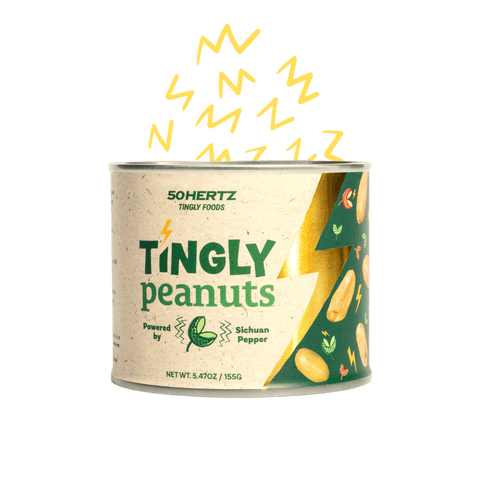
Yes — and many chefs do. A 50/50 blend gives you the sparkle and citrus of green with the warmth and depth of red. It’s a great all-purpose seasoning for noodles, dumplings, stir-fries, or even popcorn. In fact, our beloved Tingly Sichuan Pepper Peanuts uses both red and green.
Just toast each type gently, grind them together, and store in an airtight jar. Sprinkle to finish dishes or mix into rubs and sauces.
Quick Tip: When to Use What
If you’re cooking seafood, making cold dishes, or working with bright, acidic flavors — go with green. If you’re building a deep, oily broth or stir-frying with chilies and garlic — red is your friend. When in doubt, green = bright & fresh; red = warm & rich.
Final Thoughts
Green and red Sichuan peppers aren’t just two versions of the same thing — they’re distinct tools in the flavor toolbox. One brings brightness and bite. The other brings depth and comfort. Together, they’re essential to understanding what makes Sichuan cuisine sing.
Whether you’re just discovering má or have been cooking with it for years, choosing higher-quality pepper — and using it the right way — can unlock entirely new levels of aroma and flavor.
Want to try the real thing?
We source high-grade, single-origin Sichuan peppers with no stems, no seeds, and no dye — just pure má magic. Choose red, green, or try both.




Commentaires (0)
Il n'y a pas de commentaires pour cet article. Soyez le premier à laisser un message !