

At 50Hertz, we’ve always loved foods that create energy around the table.
Yao Zhao, founder of 50Hertz Tingly Foods, grew up in Chongqing, where málà flavors and Sichuan pepper are deeply woven into social eating culture. Hot pot gatherings stretch for hours. Drinks keep flowing. Conversations drift between food, gossip, arguments, and laughter.
Honestly, a great mahjong night feels very similar.
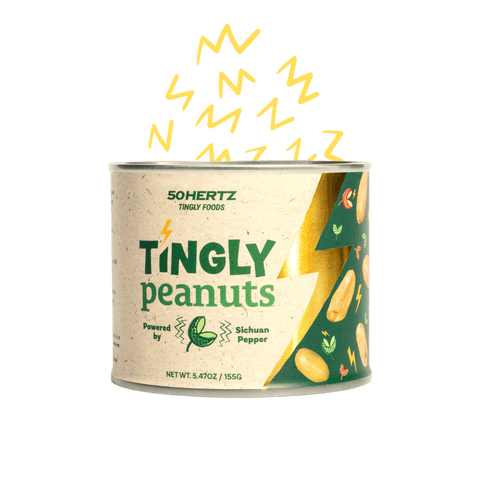
Our Tingly Peanuts and Tingly Cashews were designed for exactly these kinds of long social gatherings: hot pot nights, drinks with friends, dinner parties, and yes, mahjong tables.
Because the best mahjong nights aren’t really just about winning.
They’re about the atmosphere.
 Image: Every mahjong night starts with walls, tiles, and snacks on the table. We’d love for 50Hertz’s Tingly Peanuts and Tingly Cashews to become part of that ritual too.
Mahjong Is Sensory

Mahjong often starts with that rhythmic, almost ritualistic shuffling.
The clackity-clack of mahjong tiles crashing together as players shuffle the tiles before the walls are built and the game begins.
A good mahjong table should feel loud, alive, and slightly chaotic. Someone’s arguing over a discard. Somebody else is laughing too hard. Snacks slowly disappear between turns. One round quietly turns into another.
Even the name carries sound inside it. Mahjong — also written mah jongg, mah-jongg, majiang, or simply “mahj” in some American circles — is widely believed to come from the Chinese word for sparrow (麻雀 / máquè), partly referencing both the chatter around the table and the clicking sound the tiles make.
Mahjong is sensory in every direction: sound, rhythm, touch, tension, conversation, atmosphere.
And honestly, that’s probably part of why málà flavors feel so naturally at home around mahjong tables too.
The Meaning of Má (麻)

In Chinese, the “ma” in mahjong (麻将 / 麻將) and the “ma” in málà (麻辣) share the same character: 麻.
In málà cooking, má refers to the tingling, numbing sensation created by Sichuan pepper.
Not spicy in the usual capsaicin sense.
More like buzzing electricity. Citrus. Vibration. A sensation that wakes up your mouth and makes you immediately reach for another bite.
That same buzzing energy exists around a good mahjong table too.
Tiles clacking. People talking over each other. Somebody dramatically slamming down a tile. Somebody reaching into the snack bowl without even looking.
Mahjong is sensory.
Málà is sensory.
They wake up the room in similar ways.
Mahjong Has Always Been a Snacking Game

The best mahjong nights were never really just about winning anyway.
Someone says “one more round,” East Wind quietly becomes South Wind, another drink appears, and suddenly it’s three hours later and nobody has moved.
Traditional mahjong tables were rarely empty. Tea, beer, fruit, sunflower seeds, peanuts, dried plums — there was always something nearby to snack on between turns.
Part of what makes mahjong feel so different from modern entertainment is that it creates lingering.
You sit around one table for hours. Conversations drift in and out between hands. Somebody starts gossiping. Somebody gets way too competitive. Everybody slowly falls into the rhythm of the game.
Mahjong doesn’t just create gameplay.
It creates atmosphere.
Why Mahjong Feels Relevant Again
 Image: Young and old players gathered around a mahjong table — part of the game’s enduring analog appeal as a social ritual that brings generations together offline.
Part of mahjong’s resurgence feels obvious.
The tiles are beautiful. The shuffle sounds incredible. It feels good to sit around a table with people again.
After years of everyone staring into digital screens, mahjong feels weirdly refreshing because it’s stubbornly analog.
You cannot casually scroll TikTok while tracking tile discards, reading the table, building your hand, and trying to predict what everybody else is waiting for.
Everybody ends up actually present.
That’s part of why younger mahjong communities have exploded recently, from Chinatown cafés and neighborhood clubs to anime-inspired riichi groups, stylish “Mahj” gatherings, and all-night social games.
People want rituals again.
They want excuses to stay offline a little longer.
And mahjong naturally creates the kind of atmosphere modern life rarely leaves room for anymore:
long conversations, shared snacks, drinks lingering on the table, and hours disappearing without anybody noticing.
Mahjong Nights Are Back

Image: Intergenerational Mahjong Series on 4/19 at a senior center in SoCal, sponsored by 50Hertz.
And that same energy is showing up in mahjong communities across the country now, from Mahjong United and East Never Loses to Common Ground Mahjong and Three Dragons Mahjong Club — all communities we’re proud to sponsor with 50Hertz snacks.
Some tables are deeply traditional. Others are full of younger players discovering mahjong through anime, family, Chinatown nightlife, or modern designer sets.
But the common thread feels the same: people gathering around one table for hours, eating, arguing, competing, gossiping, and slowly falling into the rhythm of the game.
At 50Hertz Tingly Foods, those are exactly the kinds of gatherings we love most. And honestly, if our Tingly Peanuts or Tingly Cashews become part of somebody’s regular mahjong night ritual — sitting next to the tiles, drinks, and tea on the table — that would make us very happy.




Commentaires (0)
Il n'y a pas de commentaires pour cet article. Soyez le premier à laisser un message !