
We didn’t build 50Hertz with a list of target restaurants in mind. There wasn’t a moment where we said we wanted to get into Michelin kitchens, cocktail bars, hotels, or tech campuses.
At the beginning, the focus was much simpler: getting people to taste Sichuan pepper the way we knew it could be experienced. Fresh. Aromatic. Actually tingly.
For a long time, that meant a lot of small, quiet interactions. Sending samples. Talking to chefs. Showing up to events and demos. Following up. Most of it didn’t lead anywhere immediately.
But every so often, someone would get interested. And when they did, they usually took it in their own direction.
Over time, enough of those moments turned into real partnerships that we ended up creating a page dedicated to the people and kitchens we’ve worked with. Looking back, we started noticing something we didn’t expect. The same ingredient was showing up in very different kinds of kitchens.
Not because we were pushing it into those places, but because people kept finding their own reasons to use it.
At the Pinnacle of Fine Dining

Image: From Michelin-star kitchens to iconic restaurants, 50Hertz Sichuan pepper is showing up where every ingredient has to earn its place on the menu.
Some of the earliest signals came from fine dining kitchens.
Restaurants like Eleven Madison Park, Le Bernardin, Smyth, and Alinea began incorporating 50Hertz’s Sichuan pepper into their work, sometimes quietly and sometimes more directly.
These are kitchens where nothing is accidental. Every ingredient has to justify itself not just in flavor, but in how it shapes the entire dish.
What’s been interesting is that Sichuan pepper has found a place there without needing to be framed as something novel.
 Image: Honey-lavender duck at Eleven Madison Park, dry-aged 14 days and glazed with honey, lavender, and 50Hertz Sichuan pepper. Served with apple jam, daikon ribbons, and duck jus.

Image: Spice-poached Bartlett pear with etrog citron confit at Le Bernardin, finished with 50Hertz Sichuan pepper. A subtle but deliberate use within one of fine dining’s most exacting kitchens.
 Image: “Coal Spiral Bean” at Alinea — spiral beet with mustard and chili, seasoned with 50Hertz Sichuan pepper. Set over Chinese mustard vinaigrette, finished with shiso flower.
In a fine dining context, Sichuan pepper isn’t used as something flashy. It’s used as something structural, shaping how a dish moves across the palate.
It changes how richness lands and keeps flavors from flattening out over time. It adds movement and vibrations to dishes that might otherwise feel static, especially in courses built around fat, sweetness, or repetition.
Seeing it used that way, alongside some of the most disciplined cooking in the world, has been one of the more unexpected parts of this process. It’s also something we don’t take lightly.
In restaurants that feel closer to home
At the same time, some of the relationships we value most didn’t start in those kitchens.
They started with conversations, with people who were open enough to try something unfamiliar without needing to know exactly where it would lead.

State Bird Provisions is one of those examples. What began as a simple introduction turned into a full collaboration, with Sichuan pepper moving through a dining room built on motion and discovery.
Dishes weren’t explained in detail and didn’t need to be. They moved through the room on carts, appearing across savory and dessert, allowing guests to encounter the ingredient naturally.
Embed State Bird video: https://www.youtube.com/shorts/8FeHDngpLvs
Places like Mister Jiu’s and Benu approached it differently. Their use was more subtle and more integrated, with the ingredient showing up in ways that felt native to their kitchens rather than imposed from the outside.

Image: Tingly crispy peanuts at Mister Jiu’s, coated in chili and 50Hertz Sichuan pepper, topped with fried anchovies for crunch and depth.
 Image: Crispy frog’s legs at Benu, brined with garlic, five spice, and 50Hertz Sichuan pepper, then tossed with chili, fried garlic, and basil.
Then there are places like Toki Underground, which feel more personal. Long before 50Hertz, that was where we used to go. Late nights, bowls of ramen, the kind of place you don’t think twice about returning to.
Seeing our Sichuan pepper oil show up there now wasn’t planned. It just happened over time.

Image: Tingly Garlic Tonkotsu at Toki Underground, finished with 50Hertz Sichuan pepper oil. A personal favorite that came full circle.
In more casual dining, the effect becomes even clearer.
At events like Tingly Burger Night, Sichuan pepper moved through cheeseburgers, fries, nuggets, and brittle.
It wasn’t about reinvention. It was about shifting how familiar food is experienced.

People didn’t need it explained. They just tasted it, paused, and went back for another bite. That’s usually the clearest signal that something is working.
In beverages: where experience comes first

Some of the most revealing collaborations happened in drinks, bars, and breweries, where subtlety matters and small changes show up immediately.
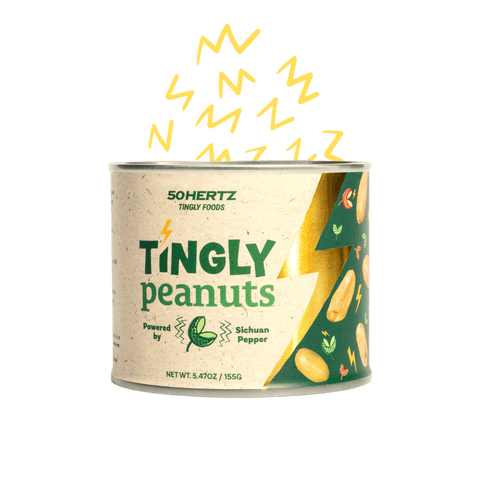
At Lost Generation in Washington, DC, our relationship started simply, with our tingly peanuts sitting behind the bar.
The reaction was immediate, and it didn’t take long before that curiosity turned into a collaboration. That’s how Tiger Spirit came together with Lost Generation and Bluejacket, built around Sichuan pepper, chrysanthemum, orange peel, and coriander.

That same instinct has started to appear in coffee as well. In China, cafés have begun experimenting with green Sichuan pepper in espresso drinks, not to add heat, but to bring clarity and lift to milk and chocolate notes.

In chocolate, ice cream, and sweets
Some of the earliest collaborations happened outside savory kitchens entirely.
With Goodnow Farms, Sichuan pepper showed up in chocolate, where everything is handled in small batches and nothing is rushed.

It didn’t sit on top of the chocolate as a flavor accent. It moved through it, opening the cacao and extending the finish in a way that felt fully integrated.
With NeoCocoa, that same idea took on a different form. Tingly Brittle brought Sichuan pepper into toffee and chocolate, creating something that felt familiar at first and then shifted unexpectedly as the tingle set in.

In ice cream, the effect became even more pronounced. At Ice Cream Jubilee, Sichuan pepper didn’t compete with sweetness, it balanced it, cutting through richness and creating a progression that unfolded over time.
Cold didn’t mute the sensation, it sharpened it.

In the formats people already use

Some collaborations are about pushing boundaries, while others are about making something easier to use.
The Tingly Blend, created with San Juan Island Sea Salt, started with a simple stocking order. They were carrying our Tingly Peanuts in their farm store, and when we connected, it turned out we’d both been thinking about the same idea: a tingly salt.
The timing lined up. We were exploring ways to bring Sichuan pepper beyond snacks, and they were looking for a way to translate that same sensation into a seasoning.
What came out of that wasn’t just a product, but something we built together. A salt designed to be used the way people already cook, something you can reach for without thinking too much about it.
In hospitality: where consistency matters

There’s another layer of partnerships that looks very different from chef collaborations, and that’s hospitality. Groups like The Ritz-Carlton, Four Seasons, and Waldorf Astoria aren’t building menus around novelty.
They are building for consistency across locations, teams, and thousands of guests. That’s where our Sichuan pepper shows up differently, not as a feature, but as a reliable tool. Something that can be integrated into dishes and deliver the same result every time.
That kind of validation is quieter, but it carries a different kind of weight.
Where it quietly becomes normal

There’s one more layer that’s less visible, but just as important. Some of our partnerships don’t show up on menus at all.
They show up in tech campuses, office kitchens, and large-scale food programs at companies like Google, Meta, and Amazon. These are places where food isn’t meant to stand out, it’s meant to work.
When our Sichuan pepper shows up there, it isn’t labeled or explained. It’s just folded into everyday meals. And that’s when something shifts from being interesting to becoming normal.
What ties it all together
Looking across all of these collaborations, from fine dining kitchens to breweries, chocolatiers, ice cream makers, hospitality groups, and tech cafeteria kitchens, the pattern is consistent.
No one is using Sichuan pepper the same way, but they’re all using it for the same reason. It does something that’s difficult to replicate with other ingredients.
It wakes things up and resets the palate in a way that keeps flavors from collapsing over time. It doesn’t make things louder, it makes them clearer.
At a certain point, you stop noticing where it came from and only notice that things taste better with it. And once you experience that, it’s hard to unsee.
Most of these collaborations started the same way, with a conversation. If you’re thinking about working with Sichuan pepper, feel free to reach out!




Comments (0)
There are no comments for this article. Be the first one to leave a message!