
I didn’t leave the World Bank on a whim.
I left because I realized I was meant to build something of my own.
For years, my life followed a path that made sense on paper.
I studied International Relations at China Foreign Affairs University in Beijing and later Economics at Johns Hopkins SAIS in Washington, D.C.
My career took me across continents, from rural electrification in India to renewable energy development in the UAE and then global clean energy policy work at the World Bank.

Image: At The Edge Of The World, outside of Riyadh on a World Bank mission to Saudi Arabia
The work mattered. The people were brilliant. The problems were important. From the outside, it looked like I had arrived exactly where I was supposed to be.
But meaning doesn’t always show up in reports or financial models.
Sometimes, it shows up at the dinner table.
A Taste That Came Home With Me
During a visit back to Chongqing for Chinese New Year, my mum made a simple cucumber salad dressed with local green Sichuan pepper oil.
 Image: with the woman who inspired 50Hertz in Shaxi, Yunnan, China
The floral aroma and gentle electric tingle were instantly familiar — a visceral reminder of growing up in Chongqing in the 1990s. It wasn’t nostalgia in a sentimental sense. It was physical. Immediate. Involuntary.
As Proust wrote,
“...when from a long-distant past nothing subsists, after the people are dead, after the things are broken and scattered, taste and smell alone, more fragile but more enduring, remain…”
For me, Sichuan pepper or huājiāo was my madeleine. I wasn’t remembering on purpose. My body recognized it before my mind did.
I returned to the U.S. with a small bottle.
A few weeks later, a simple weeknight pasta shifted something. My partner cooked one of Thomas Keller’s mushroom pasta recipes — mushrooms, shallots, parmesan. At the table, almost as an afterthought, the green Sichuan pepper oil entered the meal.


Image: Thomas Keller’s mushroom pasta salad from his book Ad Hoc At Home and our original prototype green Sichuan pepper oil
The aroma lifted the umami of the cheese. The gentle electric tingle made the dish feel alive.
Across the table, there was a moment of surprise — then a laugh. It tasted unlike anything we’d had before: citrusy, floral, buzzing.
That was when it clicked. This flavor could go beyond Chinese food.
Sichuan pepper or huājiāo didn’t belong only to a narrow idea of “Chinese ethnic food.” It deserved a much wider life. That realization led directly to our first product: a tingly green Sichuan pepper oil.
 Image: Early prototype of 50Hz Green Sichuan Pepper Oil with some greens.
The Absence That Wouldn’t Let Go
When I first moved to the U.S., I was struck by how absent Sichuan pepper was outside of restaurant kitchens.
Sichuan cuisine was known, yes — but huājiāo itself was folded quietly into málà, often flattened into mere heat or novelty rather than celebrated as a sensation in its own right.
It didn’t help that the USDA wrongly banned the spice for forty years and, even after lifting the ban, required importers to heat-treat peppercorns at 140°F — a process that destroys much of their aroma and character. A core part of my lived food experience had quietly disappeared in translation.
That absence bothered me more than I expected.
I didn’t start 50Hertz because I wanted to become an entrepreneur. I started it because I couldn’t accept that this singular sensation — one that resists easy categorization — had no real place in the American pantry.
From the beginning, I didn’t see 50Hertz as a spice company. I saw it as a sensory company.
Starting Small, Explaining Slowly
Our early days were modest. The company was entirely self-funded, built slowly from my own savings, without outside capital.
Careful sourcing from remote Chinese orchards in Sichuan. Manual and laborious harvesting by farmers navigating steep ravines, prickly thorns, and fragile oil bumps on Sichuan pepper husks.
Patient conversations over tastings. Repeating the same sentence over and over: It’s not spicy. It’s tingly.

We weren’t chasing scale. We were hoping people would pause long enough to notice.
Two months after we started selling green Sichuan pepper oil in April 2020, The New York Times described it as “an oil that tingles and transforms.”
The piece sparked an overnight response — tens of thousands of bottles sold in a matter of days.
Since then, we’ve been fortunate to be featured by Food & Wine, included in The Wall Street Journal’s gift guide, and myself described by The Guardian as “a rebel with a tingly cause.”
More than the sales, these moments gave us permission — internally and externally — to keep going.

Image: Our features in Food & Wine, the WSJ's 2025 Holiday Gift Guide, and other media mentions gave us the impetus to keep going.
What Excites Me Now
Today, what excites me most isn’t growth for its own sake. It’s the community forming around this sensation.
We now work with roughly 1,500 restaurants across the U.S., most of them not Chinese restaurants at all — ramen shops, pizza places, cocktail bars, and Michelin three-star kitchens like Eleven Madison Park. Bartenders use huājiāo in drinks.
Pastry chefs sneak it into desserts. Home cooks drizzle it on eggs, popcorn, tacos, in coffee, and ice cream.
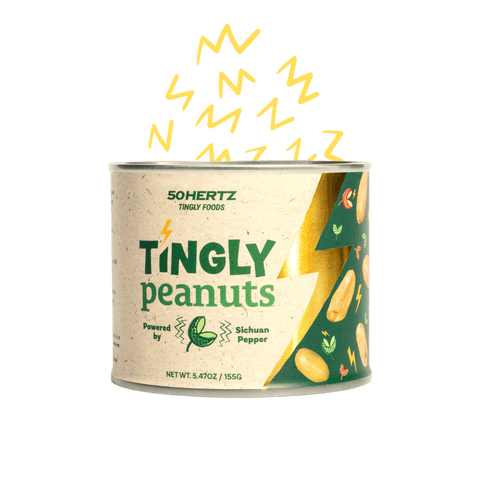
Sichuan pepper is no longer treated as a wildly niche ingredient. It’s becoming a creative tool. What began with a single green oil has since grown into a broader Tingly lineup — green and red Sichuan pepper oils, dried whole spices, salt blends, peanuts, brittle and chocolate, and cashews — with more innovations already underway this year (stay tuned!)
 Image: Our full product lineup evolution. Image not to scale.
Why It Still Feels Early
At the same time, it still feels early. It took me five years to finally step away from my previous career and go full time on this work — a leap I only made in 2025.
We’re building a small team, learning as we go. I still feel moments of doubt — even imposter syndrome — alongside the excitement.
That uncertainty doesn’t worry me. It keeps us on our toes.
That spirit — good ingredients, unwavering attention to detail, and a curiosity that keeps expanding — is what we try to champion.
Traditions don’t survive by being frozen. They survive by being used.
Why 50Hertz
 Image: An image of me with Dr. Patrick Haggard, FBA, the researcher who measured that Sichuan peppers vibrate at 50 Hertz.
Scientists at University College London once studied Sichuan pepper and found that the frequency of its tingling sensation consistently registers at around 50 Hertz.
The molecule responsible, hydroxy-α-sanshool, activates nerve endings where the skin is thinnest — the lips, the mouth — creating a buzzing, numbing sensation unlike anything else.
That felt like the right name.
Because what we’re really offering isn’t heat. It’s attention.
Leaving — Without Rejecting
Leaving the World Bank wasn’t dramatic. I didn’t burn bridges. I still care deeply about systems-level change.
But I’ve come to believe that impact doesn’t only live at scale.
Sometimes, it lives in helping someone experience a sensation they didn’t know existed — and watching their face change mid-bite. Or helping someone recover their taste buds after a bout of long COVID.
50Hertz is my way of reviving a fragile trade, reaching across cultural aisles, and rescuing meals from boredom — not by overpowering them, but by waking them up.
I didn’t leave one world behind.
I’m still translating. And in many ways, we’re only just getting started.




Comments (0)
There are no comments for this article. Be the first one to leave a message!