

One year ago, something surreal happened.
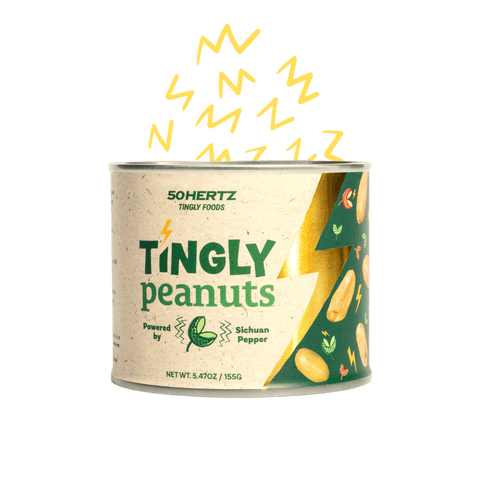
50Hertz’s tingly peanuts were featured in Food & Wine.
At the time, it felt like a moment.
Looking back, it feels like a turning point.
Because Food & Wine isn’t just a magazine — it’s one of the institutions that shapes what enters the American food conversation.
And somehow, a small, tingly, mouth-numbing pepper from Southwest China — something most people couldn’t even pronounce — made it onto their pages… with us attached to it.

This month marks one year.
So we wanted to do three things:
1) look back at that moment and how it happened,
2) zoom out into the history of Food & Wine itself, and
3) highlight five recipes that show how Sichuan pepper has made its way into everyday cooking.
How It Happened (Completely by Accident)
What makes this story even better is that we didn’t pitch it.
There was no PR agency, no cold outreach, no real strategy behind it. It happened organically.
Back in 2023, Mary — one of our customers — came to a demo in Portland, Oregon. She tried the peanuts: that first hit of citrusy, electric tingle — and loved them.
In conversation, she mentioned something we didn’t expect: her daughter was the Executive Editor at Food & Wine.
She took some product back with her, shared it, and pitched the idea internally.
That was it.

No deck, no campaign — just product, experience, and word of mouth.
And somehow, that made its way into one of the most respected food publications in the country.

The Feature That Changed Everything
The article — “Szechuan-Spiced Peanuts Make for a Serious Snack Upgrade” — captured exactly what we’ve always tried to do: not just sell a snack, but introduce a sensation.
As Food & Wine described our peanuts:
“A crunchy, salty, zesty snack with a pronounced but pleasant buzzing sensation that fades just quickly enough to make you want another one.”

That’s the entire point.
But the piece also named the real challenge:
“Most Americans, they don’t know what to do with Szechuan pepper.”
It shows up in recipes, in restaurant dishes, in theory — but not in a way that feels immediate, intuitive, or easy to try. There’s a gap between curiosity and use.
That’s exactly what we set out to solve. Not another ingredient. Not another instruction manual — something you can just open and understand.
Which is why the answer became peanuts: a familiar format, a low barrier, a direct experience. Something approachable, snackable, immediate.
A way in.
A Love Letter to Food & Wine
Food & Wine got its start in 1978 — but not the way you’d expect.
After years of searching for investors, the founders convinced Hugh Hefner to publish their debut issue — originally titled The International Review of Food & Wine (later shortened in 1981) — as a special 18-page insert in the March 1978 issue of Playboy.
At the time, Playboy was one of the most culturally influential magazines in America — known not just for its imagery, but for serious journalism, long-form interviews, and shaping the broader lifestyle conversation.

Image: The original March 1978 Playboy insert where Food & Wine first appeared.
It began, quite literally, as a magazine inside a magazine.
And from the start, it carried weight — with contributors like James Beard and Jacques Pépin (legendary French chef) signaling that this wasn’t just an experiment, but something serious.
That scrappy, unlikely origin is part of why this means so much to us.
Because a year ago, we somehow became a small part of that same story.
And you can see how that story has evolved — not just in recent features, but across their archives.
Especially in the recipes, where ingredients like Sichuan pepper quietly move from the margins into everyday cooking.
5 Sichuan Pepper Recipes from Food & Wine’s Archives
If you want to understand where Sichuan pepper sits today, this is the clearest place to look.
Not just in traditional dishes — but in how it’s been adapted, reinterpreted, and folded into everyday cooking.
1. Spicy Honey-Soy Brussels Sprouts
:max_bytes(150000):strip_icc():format(webp)/Spicy-Honey-Soy-Brussels-Sprouts-FT-RECIPE0226-e9229650f47a4f038accf62565dbd6f7.jpg)
Image: Photo by Greg Dupree, food styling by Emily Hall, prop styling by Claire Spollen, via Food & Wine
A perfect example of how Sichuan pepper entered the American vegetable playbook.
Taking cues from Chinese liáng bàn cài — cold-tossed dishes built on soy, vinegar, and aromatics — the dressing layers savory, sweet, and tangy elements with precision.
A drizzle of Sichuan pepper oil — used here as a finishing touch — adds a floral, citrusy lift and that subtle numbing tingle — the same effect we chase with our green and red pepper oils — turning something familiar into something unexpectedly addictive.
Paired with soy, honey, and Chinkiang black vinegar, it doesn’t overpower — it completes the system.
This is how ingredients cross over: quietly, then all at once.
2. Crispy Salt-and-Pepper Air Fryer Tofu with Asparagus
:max_bytes(150000):strip_icc():format(webp)/Crispy-Salt-and-Pepper-Air-Fryer-Tofu-with-Asparagus-FT-RECIPE0522-83b9d3bf9ba9496fab2b9bfcb4c06853.jpg)
Image: Photo by Jennifer Causey, food styling by Ruth Blackburn, prop styling by Julia Bayless, via Food & Wine
A modern take on a Cantonese classic — salt-and-pepper tofu (椒盐豆腐, jiāo yán dòu fǔ) — a dish built on crisp texture and punchy, aromatic seasoning.
Here, that foundation is reworked for a home kitchen: ground Sichuan pepper is folded into a soy-based marinade — not just sprinkled on — coating the tofu in a savory, lightly numbing layer of flavor.
Whether you lean green or red Sichuan pepper, you get a different expression — brighter, citrusy lift from green; deeper, warmer spice from red — the same distinction we focus on with our 50Hertz peppers.
Asparagus and air-fryer crisping bring it firmly into weeknight territory.
Some of that marinade is even reserved and drizzled back over at the end — a second hit that deepens the aroma and tingle.
3. Mala Stir-Fried Paneer
:max_bytes(150000):strip_icc():format(webp)/Mala-Stir-Fried-Paneer-FT-RECIPE0323-4d880857a14c4deab020f420f7ccca74.jpg)
Image: Photo by Jennifer Causey, food styling by Chelsea Zimmer, prop styling by Christine Keely, via Food & Wine
A clear example of how Sichuan pepper has moved beyond its regional roots.
Chef Jonathan Kung’s stir-fry uses paneer — a mild, fresh cheese — as a neutral canvas for mala. But what’s striking is how the flavor is built: the paneer is first soaked in lapsang souchong tea (a Chinese black tea), infusing it with a subtle smokiness before it ever hits the wok.
From there, the structure becomes unmistakably Sichuan.
Sichuan peppercorns are toasted alongside er jing tiao chiles and paired with Japanese sansho — layering numbing intensity with bright, citrusy lift.
What emerges isn’t just heat. It's a system — smoky, aromatic, and electric — carried entirely by the pepper.
The paneer doesn’t compete with it. It absorbs it.
And that’s the shift: Sichuan pepper isn’t confined to traditional dishes anymore — it’s being applied as a transferable flavor language.
This is the difference between using Sichuan pepper — and understanding how to build with it.
4. Kung Pao Chicken
:max_bytes(150000):strip_icc():format(webp)/kung-pao-chicken-FT-RECIPE0321-56db796f7f94439a8482c6832c41af27.jpg)
Image: Photo by Victor Protasio, food styling by Torie Cox, prop styling by Lydia Pursell, via Food & Wine
One of the most recognizable Chinese dishes in the U.S. — and one people think they already understand.
But look closer, and the structure reveals itself.
In Food & Wine’s version, Sichuan peppercorns are added early — toasted in hot oil alongside chiles, ginger, and garlic — setting the foundation before anything else enters the wok.
That order matters, because what’s being built isn’t just heat — it’s separation. The pepper cuts through the richness of the chicken, sharpens the sweetness, and lifts the aromatics so each element stays distinct rather than blending together.
And that’s the role Sichuan pepper plays here — not as a highlight, but as structure. This is how it entered the American kitchen: not as something new, but as something that was already working behind the scenes.
5. Sichuan Negroni
:max_bytes(150000):strip_icc():format(webp)/sichuan-negroni-temple-house-chengdu-blog418-b20b74fa234d47b081adca93a4a870d2.png)
Image: courtesy of Jing Bar at the Temple House in Chengdu, via Food & Wine
This is where things move beyond food entirely.
At Jing Bar in Chengdu, Campari is infused with Sichuan pepper, pulling its citrusy aroma and numbing lift directly into the structure of the drink.
The effect is subtle but immediate. Bitterness sharpens, aromatics lift, and the finish lingers just a little longer than expected.
Once you see it, it’s not just about a Negroni. Sichuan pepper becomes something you can build with across drinks — from highballs and spritzes to margaritas and even Martinis, where aroma and finish carry more weight.
We’ve explored this ourselves — especially in margaritas and citrus-forward cocktails — looking at how Sichuan pepper behaves across formats and how small shifts in structure change the way the tingle shows up. In our guide to Sichuan pepper in cocktails, we break this down across nine drinks.
The idea is simple: not adding flavor, but changing how it’s experienced.
This is what it looks like when an ingredient fully crosses over.
One Year Later — And Still Tingly

A year ago, being featured in Food & Wine felt like an arrival. Now it feels more like alignment.
Because the thing we’ve been obsessed with, this strange, electric, misunderstood pepper, is no longer niche. It’s showing up everywhere, not as a novelty but as something people are beginning to understand how to use.
Across vegetables, proteins, and even cocktails, the pattern is the same: Sichuan pepper isn’t just being added, it’s being built with.
That shift has shown up in our own work as well. What started with peanuts has expanded into cashews, tingly salt blends, brittle, chocolate, and oils — each one exploring a different way the sensation can show up across formats, with more on the way.
Not just as flavor, but as structure.
From snacks to seasoning to drinks, the goal has stayed the same: make something unfamiliar feel intuitive, something people don’t just try once, but start to understand.
A year ago, most people didn’t know what to do with it. Now they’re starting to, and if this past year is any indication, we’re still at the beginning.




Comments (0)
There are no comments for this article. Be the first one to leave a message!